Does Your Canvas Course Design Promote a Sense of Belonging?

grey puzzle assembled with one yellow piece

“When students experience a sense of belonging in a learning environment, we see both immediate and long-term positive consequences for their academic performance and well-being”

(Healey & Stroman, 2021).

Perhaps you’ve wondered: “Can course design impact belonging?”
While positive interactions and culture play an outsize role in creating safe and welcoming learning spaces, the learning environment itself has been shown to affect students’ sense of belonging. In both physical classrooms and online courses, learners take in subtle cues from the environment that signal whether they belong (Cheryan et al., 2009). This ambient belonging can affect learner engagement, motivation, and success.

To build more inclusive and effective learning environments, instructors and designers can promote ambient belonging in Canvas courses through identity safety cues. Utilizing research-backed cues in your courses can contribute positively to a learner’s sense of belonging (Kizilcec, 2017), which ultimately serves their well-being and academic performance!

Let’s explore simple ways to design for a sense of belonging in Canvas and some tools to streamline the process for both individuals and institutions:

Utilize Representative Imagery. Help your learners see themselves in the course with representative imagery. A growing body of research shows that “visual cues in online learning environments [can] activate psychological biases and make certain groups of learners […] feel unwelcome” (Kizilcec et al., 2020). Embedding images, videos, and content from creators that reflect your learner population may help develop ambient belonging (Kizilcec, 2017).

DesignPLUS image tool searching for images of diverse student groups
With DesignPLUS, institutions can curate image collections and make them easily available to users while editing in Canvas. Also, the DesignPLUS Upload/Embed Image tool allows users to search free image repositories for course visuals from within the RCE!

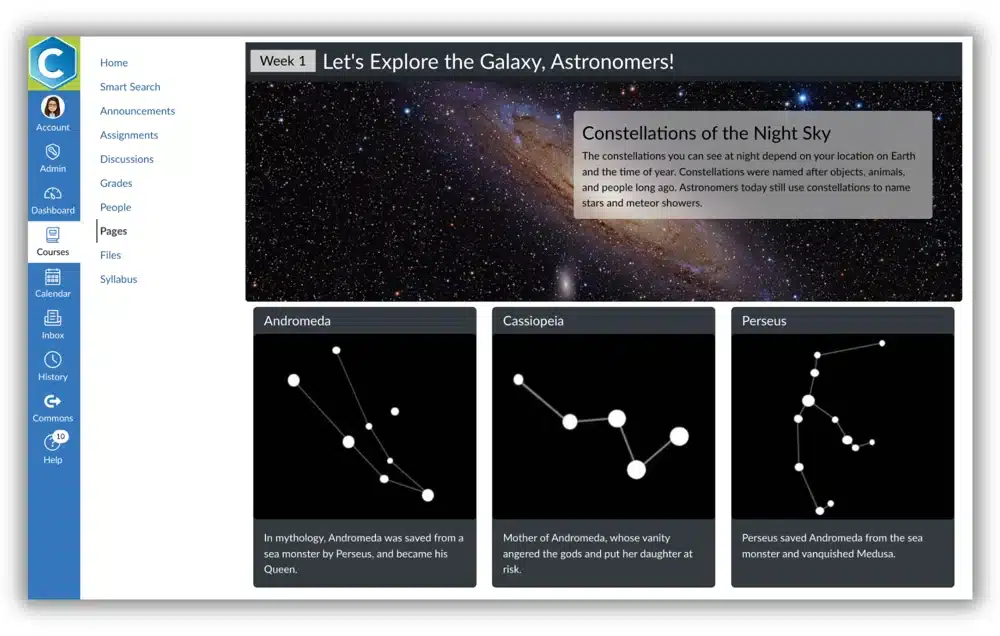
Leverage Group Identity. Promote unity and belonging by emphasizing your learners’ shared identity: members of your institution, aspiring teachers, curious science-explorers! Even without a physical classroom, online courses can foster a sense of community by layering institution-specific images, colors, and language (Welcome, Tigers!) or domain-specific details (Let’s dive in, oceanographers!) in and across courses. Here, casting the group identity as the most salient identity encourages connection and can act as a buffer against other social threats (Cikara et al., 2014; Holmes et al., 2019; Van Bavel, 2021).

Embed Instructor Presence. Utilizing an instructor welcome message–especially when embedding a video or an accompanying image–develops instructor presence and increases social belonging for learners (Kizilcec et al., 2020). These messages can be designed as an announcement template or as a staple on a course home page to promote a sense of belonging from day one.

DesignPLUS makes it easy to integrate images and videos with accompanying text. Institutions can even make pre-designed, customizable welcoming templates available to instructors right when editing in Canvas.
With DesignPLUS institutions can easily infuse their branding into Canvas courses through theme colors, banner images, and template content.

“Our courses have had a more consistent design and navigation, better branding for our university, and more positive comments from students than ever before…”
– Melissa Kemp, Instructional Designer, Dordt University

Learn More:

Want to see how easy DesignPLUS makes embedding visuals to increase identity safety cues? Watch this short video below!

Citations:

Cheryan S, Plaut VC, Davies PG, Steele CM. Ambient belonging: how stereotypical cues impact gender participation in computer science. J Pers Soc Psychol. 2009 Dec;97(6):1045-60. doi: 10.1037/a0016239. PMID: 19968418.

Cikara, M., & Van Bavel, J. J. (2014). The Neuroscience of Intergroup Relations: An Integrative Review. Perspectives on Psychological Science, 9(3), 245-274. https://doi.org/10.1177/1745691614527464

Healey, K., & Stroman, C. (2021). Structures for belonging: A synthesis of research on belonging-supportive learning environments. Website: https://studentexperiencenetwork.org/wp-content/uploads/2021/03/Structures-for-Belonging.pdf

Holmes, J.M., Bowman, N.A., Murphy, M.C. et al. Envisioning college success: the role of student identity centrality. Soc Psychol Educ 22, 1015–1034 (2019). https://doi.org/10.1007/s11218-019-09493-7

Kizilcec, R. F. (2017). Identity, threat, and belonging in online learning environments (Doctoral dissertation, Stanford University).

Kizilcec, René & Saltarelli, Andrew & Bonfert-Taylor, Petra & Goudzwaard, Michael & Hamonic, Ella & Sharrock, Rémi. (2020). Welcome to the Course: Early Social Cues Influence Women’s Persistence in Computer Science. 1-13. 10.1145/3313831.3376752.

Van Bavel, Jay. (2021). Identity Myths Busted [Video]. New York University. https://www.nyu.edu/about/news-publications/news/2021/december/identity-myths-busted.html


Name

Position

Description