Design Matters Digest: April 2026 Edition

Universal Design for Learning Bonus Edition

A newsletter bringing together research and action for inclusive online course design.
A lightbulb on a computer screen spreads into dozens more lightbulbs

Is It Possible to Scale Universal Design Principles in Canvas?

Welcome to the April 2026 edition of Design Matters Digest, a newsletter that explores elements of online course design and the research that can help you improve your Canvas courses. In the first three months of 2026, the Digest focused on building Universal Design for Learning (UDL) principles into Canvas course design. Based on audience suggestions from that mini-series, we’re bringing you a bonus feature, focusing on strategies to support and scale universal design principles across Canvas courses.

“Ultimately, it doesn’t matter how great an educational idea or intervention is in principle; what really matters is how it manifests itself in the day-to-day work of people in schools,”
(Sharples et al., 2018).

Research has shown that designing for learner variability leads to more inclusive, effective learning experiences (CAST, 2024). What’s exciting is that the CAST UDL GuidelinesTM provide a structured set of considerations that educators and designers can utilize to inform their thinking and course building. Yet research also shows that broad Universal Design for Learning adoption and implementation are affected by a variety of factors, from buy-in to understanding to technological support (Altowairiki, 2023). Add to the equation that a core tenet of the UDL Guidelines is designing for learner variability–which can run counter to the idea of developing a single, replicable course design–and you may be wondering whether it’s even possible to scale up universal design practices in Canvas.

However, if we recognize scale not as rigid standardization, but as supported implementation, institutions can lean on research-backed strategies to design and deliver more inclusive learning experiences across courses and programs.

Let’s explore some tips for scaling universal design in Canvas and a few tools that make the journey much more efficient:

Model, model, model!

If you’re trying to scale universal design practices in Canvas, it’s likely you’ll engage your educators and designers in learning about UDL. Take that opportunity to walk the talk by designing templates and training courses that showcase UDL principles in action–and call out those moments as strategies your audience can borrow! Concrete examples and models have been shown to be more effective for promoting teacher learning and concept implementation than general principles alone (Darling-Hammond et al., 2017; Hill & Papay, 2022).
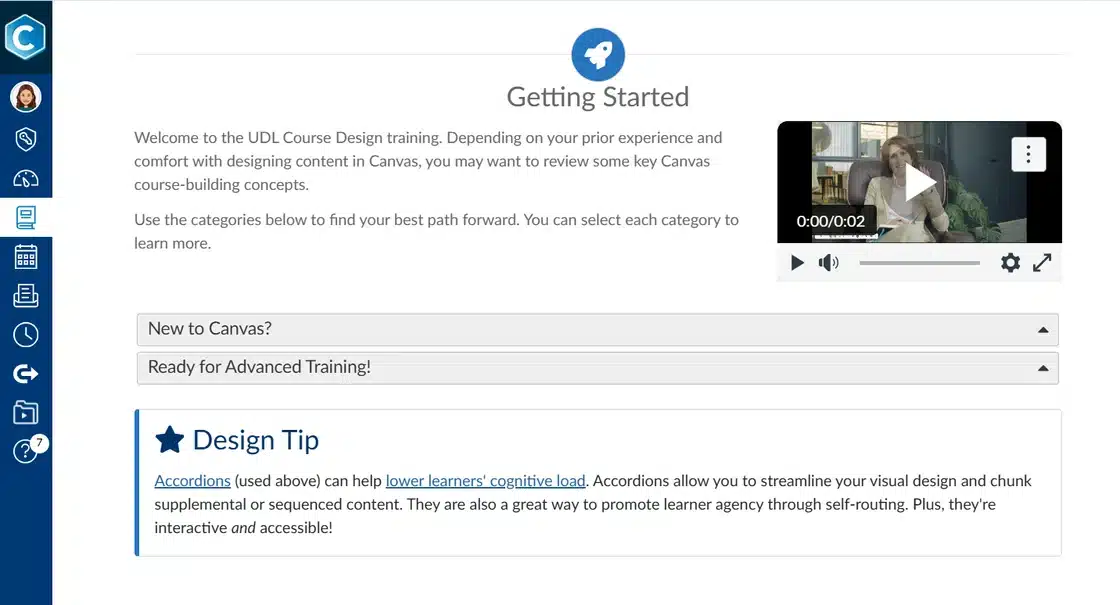
A DesignPLUS Callout feature on a Canvas course page draws attention to a design tip explaining why and how to use Accordions for learner choice
DesignPLUS Callouts provide an easy way to draw attention to content–such as universal design tips in a professional development course–all at the touch of a button in Canvas!

Provide Useful, Flexible Templates

Research shows templates can be an effective vehicle for keeping course design up-to-date with accessibility considerations and other evidence-based practices (Goomas & Czupryn 2019; Huun & Hughes, 2014). Yet, UDL principles remind us that one-size does not fit all learners (nor instructors), so aim to design easily-customizable templates that provide educators a strong foundation without removing their agency and voice. Think of providing high-value, purpose-specific templates, such as a structured choice assignment template or a multimedia content page. To really maximize scaling efforts, encourage instructors to share with colleagues what they’ve developed as a template!
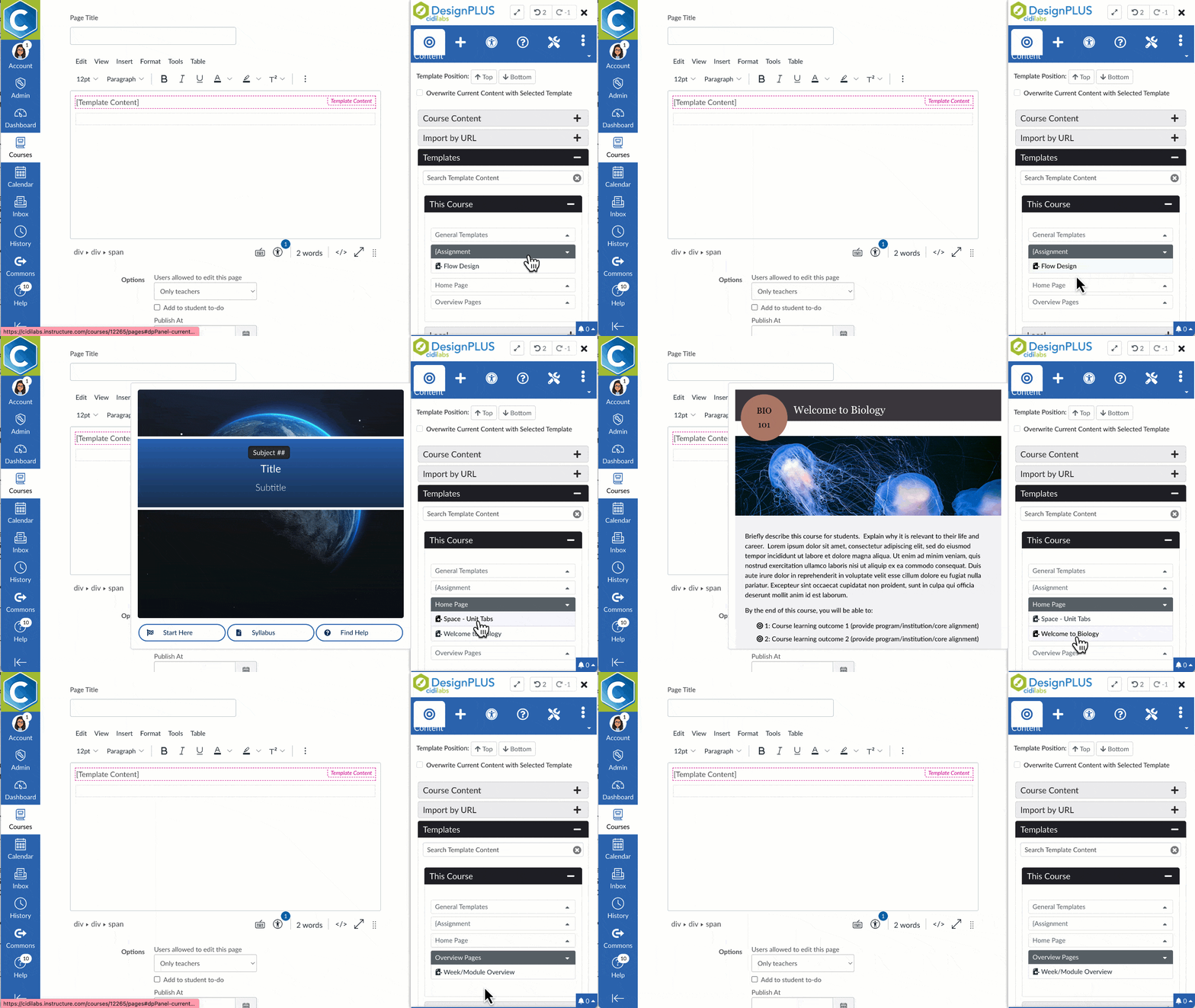
Previewing various template designs using the DesignPLUS Sidebar in the Canvas Rich Content Editor
With DesignPLUS, you can design and provide whole item templates as well as custom content blocks and html snippets for an endlessly flexible template approach, all right where editing in Canvas. We also have a DesignPLUS Library full of ready-to-use templates shared by designers and educators like you!

Embed Support Strategically

Remember that instructors and designers are learners too and thus benefit from support as they implement UDL guidelines! Research shows that just-in-time, job-embedded learning opportunities support instructors at the moment of need and allow for immediate practice, as well as a more tailored experience (Calleja et al., 2021; Croft et al., 2010). So, level up those flexible templates mentioned above by adding support information and linked resources, such as a guide to captioning videos on the multimedia content template or a reminder about alternative text on a template with a placeholder image.
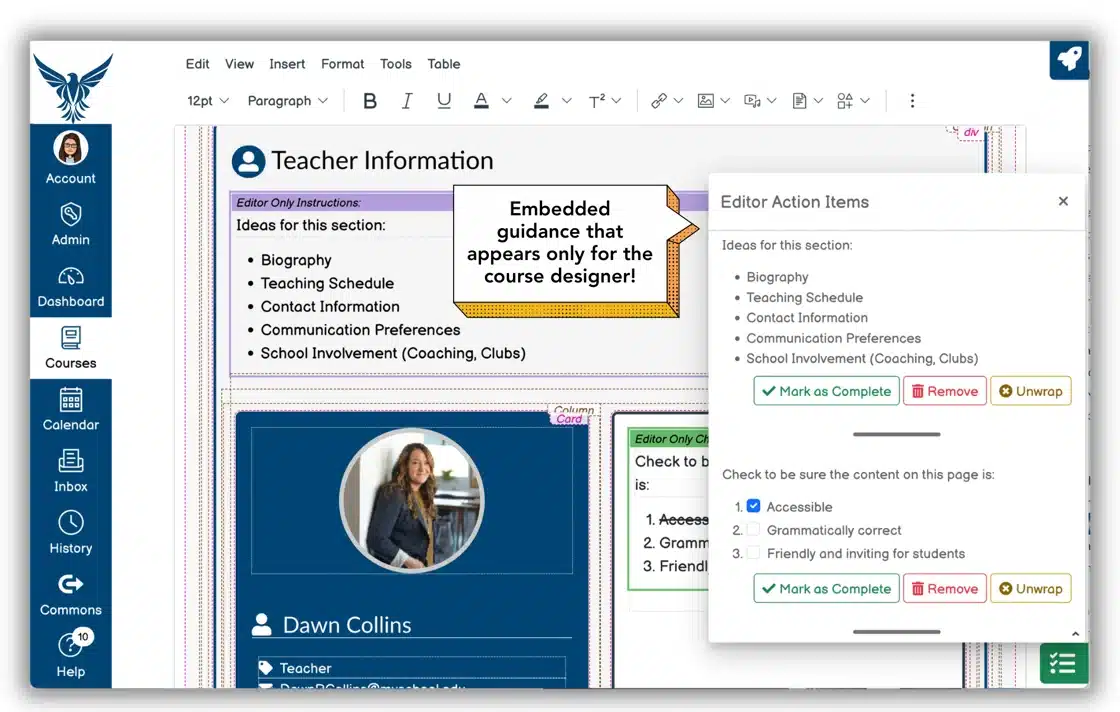
Editor Action Items popup next to Canvas home page
With DesignPLUS Action Items, you can add instructions, resources, suggested text, and even fillable prompts while editing in Canvas. Action Items are invisible to learners but visible to instructors and designers right where needed!

Companion Webinar - Join Us!

📣 Exciting news: We’ve partnered with CAST, the organization behind the CAST UDL GuidelinesTM, to bring these tips to life and do a deeper dive into the research and strategies on April 28th at 11am MT in our upcoming webinar Scaling Universal Design in Canvas. Register now!

“We have created [DesignPLUS] templates for everything in Canvas to help reduce the cognitive load on our students and create an accessible and responsive design. Feedback from our students has been extremely positive.”
– Nick Wilson, Team Lead of Instruction Systems Administration, Butler University

Citations
Altowairiki, N. F. (2023). Universal Design for Learning infusion in online higher education. Online Learning, 27(1), 296-312.

Calleja, J., Foster, C., & Hodgen, J. (2021). Integrating” Just-in-Time” Learning in the Design of Mathematics Professional Development. Mathematics Teacher Education and Development, 23(2), 79-101.

CAST (2024). CAST Universal Design for Learning Guidelines version 3.0.

Croft, A., Coggshall, J. G., Dolan, M., & Powers, E. (2010). Job-Embedded Professional Development: What It Is, Who Is Responsible, and How to Get It Done Well. Issue Brief. National Comprehensive Center for Teacher Quality.

Darling-Hammond, L., Hyler, M. E., & Gardner, M. (2017). Effective teacher professional development. Learning policy institute.

Goomas, D., & Czupryn, K. (2021). Using a learning management system common template in teaching adult basic education: Opportunities and challenges. Community College Journal of Research and Practice, 45(3), 227-230.

Huun, Kathleen & Hughes, Lisa. (2014). Autonomy Among Thieves: Template Course Design for Student and Faculty Success. Journal of Educators Online. 11. 10.9743/JEO.2014.2.4.

Hill, H. C., & Papay, J. P. (2022). Building better PL: How to strengthen teacher learning. Research Partnership for Professional Learning, 1-19.

Sharples, J., Albers, B., Fraser, S., & Kime, S. (2019). Putting Evidence to Work: A School’s Guide to Implementation. Guidance Report.. Education Endowment Foundation.

Name

Position

Description